
BIRD & BECKETT CULTURAL LEGACY PROJECT
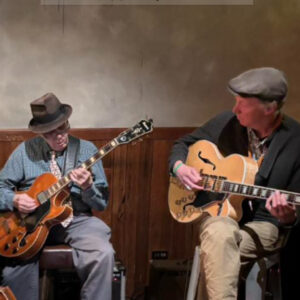
Politics and class war aside, the culture wends its way forward! Spend the evening in our cozy bookshop and enjoy this dual guitar quartet in the spirit of a legendary musician, the master guitarist George Barnes.
 When Barnes moved out to the Bay Area in 1975, he hired 30-year old guitar hotshot Duncan James along with two of Duncan’s senior colleagues, bassist Dean Reilly and drummer Benny Barth, to form what was to be Barnes’ last quartet. Duncan learned volumes from intertwining his guitar with that of Barnes, and in that vein the guitar virtuoso Ned Boynton has taken the lessons he’s learned from Duncan to carry the music on into a new century.
Ned and Duncan will satisfy your hunger for something real and beautiful tonight, with consummate musicians Simon Planting and Bob Blankenship adding the necessary on bass and drums.
$20 cover charge / byob.
Students $10; kids free.
For a reservation, call the bookshop at 415-586-3733.
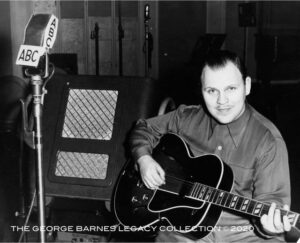 Born in 1921, at age 10 George Barnes was likely the first person to play an electrically amplified guitar — a Sears Roebuck Silvertone fitted with a pickup by his brother and fed through an amplifier.
Barnes joined the Musicians Union in 1932 at age 12, and launched a 45-year career. Between 1935 and 1937, he toured throughout the Midwest gigged around Chicago with his own bands, and by the time he was 14 he was accompanying blues vocalists such as Big Bill Broonzy and Blind John Davis. He played on 100 blues records in the 1930s.
In 1937, he was discovered by Tommy Dorsey’s clarinetist Johnny Mince, and his career really took off. On March 1, 1938, still just 16, he recorded “Sweetheart Land” and “It’s a Lowdown Dirty Shame” with Broonzy, the first commercial recordings of an electric guitar. Later that year, age 17, he was hired as a staff guitarist for the NBC orchestra in Chicago and took on arranging and conducting duties as well. He never stopped swingin’.
Barnes made two lps in 1960-61 that he orchestrated for a 10-guitar choir, and guitar duos became a successful format for him soon after, first with Carl Kress, from 1961 to 1965, and then with Bucky Pizzarelli from 1969 to 1972. A quartet with cornet player Ruby Braff followed, producing 5 lps between 1973 and 1977, the last four with Concord Records, an association which prompted Barnes’s move with his wife to the Bay Area in 1975.
Once here, he put together the George Barnes Quartet with Duncan James on guitar, Dean Reilly on bass and Benny Barth on drums. This was Barnes’s last quartet, as he died of a heart attack in 1977 at the young age of 56.
The quartet burned bright in those two years and is captured in live dates on two lps, “George Barnes Plays So Good” and “Don’t Get Around Much Anymore.” The quartet played intricate arrangements written by Barnes and performed like a chamber group, but with room to stretch out during solos and the freedom to respond to what was going on in the ensemble at any given moment.
Tonight, Duncan and Ned will give you a taste of what that was like, and a little more of their own devising.